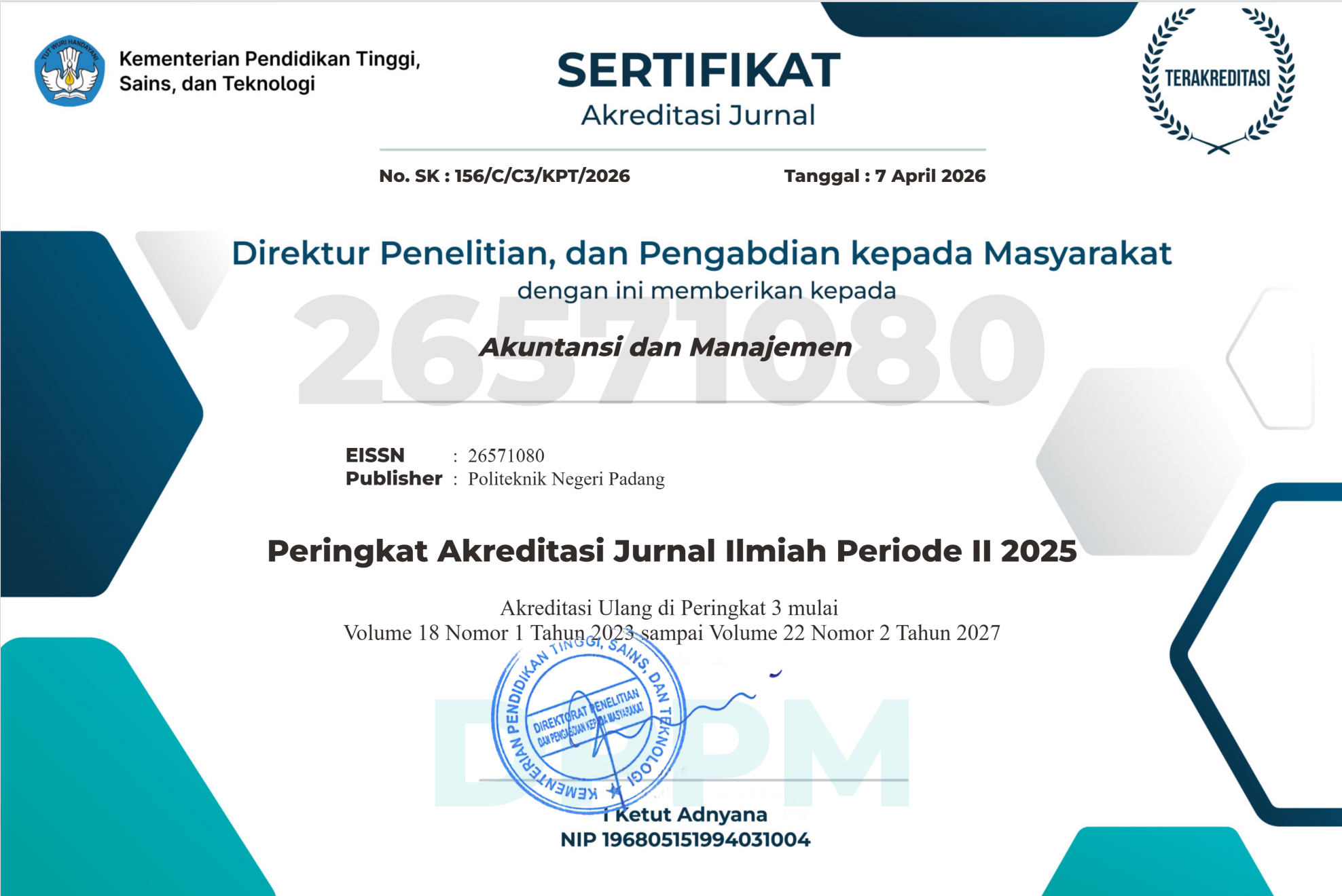
Antara Kepatuhan Formal dan Akuntabilitas Substantif: Menilik Pengelolaan Barang Milik Daerah pada Dinas Perhubungan Kota Pariaman
DOI:
https://doi.org/10.30630/jam.v21i1.416Keywords:
Regional asset Management, Barang Milik Daerah, Permendagri No.7/2024, Institutional theory, Public accountabilityAbstract
Regional asset management stands at the intersection of regulatory compliance and substantive accountability, yet the tension between these two imperatives remains underexplored, particularly under newly enacted regulations. This study investigates the management of regional fixed assets (Barang Milik Daerah/BMD) at Dinas Perhubungan of Pariaman City, evaluated against Regulation of the Minister of Home Affairs Number 7 of 2024. Employing a qualitative case study design, data were gathered through semi-structured interviews with six purposively selected informants, direct observation, and documentary analysis, with validity ensured through source triangulation and assessed against credibility, transferability, dependability, and confirmability criteria. Findings reveal that while all sixteen asset management stages have been formally executed in accordance with regulatory prescriptions, substantive compliance characterized by consistent norm internalization and quality-oriented practices remains partial. Drawing on Compliance Theory, Institutional Theory, and the public accountability framework, this study uncovers a critical institutional decoupling: organizations demonstrate coercive isomorphism in procedural adherence, yet normative and mimetic institutional pressures have not translated into genuine practice transformation. Key deficiencies persist in asset valuation, disposal, inventory accuracy, and management information system utilization. This study contributes a multi-theoretical diagnostic framework for evaluating BMD governance and argues that bridging the compliance–accountability gap requires simultaneous investment in human capacity development, integrated information systems, and strengthened internal oversight.
References
[1] Pemerintah Republik Indonesia. (1999). Undang-Undang Nomor 22 Tahun 1999 tentang Pemerintahan Daerah. Jakarta: Sekretariat Negara.
[2] Pemerintah Republik Indonesia. (2014). Undang-Undang Nomor 23 Tahun 2014 tentang Pemerintahan Daerah. Jakarta: Sekretariat Negara.
[3] Rahayu, S. (2021). Optimalisasi pengelolaan aset daerah di Pemerintah Kabupaten Lebak. Jurnal Ilmiah Ilmu Administrasi, 11(1), 29-37.
[4] Pemerintah Republik Indonesia. (2006). Peraturan Pemerintah Nomor 6 Tahun 2006 tentang Pengelolaan Barang Milik Negara/Daerah. Jakarta.
[5] Pemerintah Republik Indonesia. (2014). Peraturan Pemerintah Nomor 27 Tahun 2014 tentang Pengelolaan Barang Milik Negara/Daerah. Jakarta.
[6] Kementerian Dalam Negeri. (2024). Peraturan Menteri Dalam Negeri Nomor 7 Tahun 2024 tentang Pengelolaan Barang Milik Daerah. Jakarta.
[7] Kementerian Dalam Negeri. (2016). Peraturan Menteri Dalam Negeri Nomor 19 Tahun 2016 tentang Pedoman Pengelolaan Barang Milik Daerah. Jakarta.
[8] Pemerintah Kota Pariaman. (2017). Peraturan Daerah Kota Pariaman Nomor 14 Tahun 2017 tentang Pengelolaan Barang Milik Daerah. Pariaman.
[9] Mardiasmo. (2018). Akuntansi Sektor Publik. Yogyakarta: Penerbit ANDI.
[10] Pemerintah Republik Indonesia. (2010). Peraturan Pemerintah Nomor 71 Tahun 2010 tentang Standar Akuntansi Pemerintahan. Jakarta.
[11] BPK RI Perwakilan Provinsi Sumatera Barat. (2025). Laporan Hasil Pemeriksaan atas Laporan Keuangan Pemerintah Provinsi Sumatera Barat Tahun Anggaran 2024. Padang.
[12] Dinas Perhubungan Kota Pariaman. (2024). Data Kartu Inventaris Barang Dinas Perhubungan Kota Pariaman. Pariaman.
[13] Inspektorat Kota Pariaman. (2025). Naskah Hasil Audit Dinas Perhubungan Kota Pariaman. Pariaman.
[14] Fitriyani & Yuliansyah. (2020). Analisis pengelolaan aset tetap pemerintah daerah berdasarkan Permendagri No. 19 Tahun 2016. Jurnal Akuntansi, 19, 1-19.
[15] Labasido, E. R., & Darwanis. (2019). Analisis pengelolaan aset tetap daerah pada DPKAD Provinsi Aceh. Jurnal Ilmiah Mahasiswa Ekonomi Akuntansi, 4(2), 215-236.
[16] Fadilah, I., Muhammad, R. N., & Surya, R. T. (2021). Analisis pengelolaan aset daerah pada Pemerintah Daerah Kabupaten Bandung Barat. Indonesian Accounting Research Journal, 1(3), 446-456.
[17] Tamsir, S. H. (2018). Analisis pengelolaan aset daerah pada Biro Pengelolaan Barang dan Aset Daerah Provinsi Sulawesi Selatan. Jurnal Manajemen Publik.
[18] Scott, W. R. (2014). Institutions and Organizations: Ideas, Interests, and Identities (4th ed.). Thousand Oaks: SAGE Publications.
[19] Tyler, T. R. (2006). Why People Obey the Law. Princeton: Princeton University Press.
[20] DiMaggio, P. J., & Powell, W. W. (1983). The iron cage revisited: Institutional isomorphism and collective rationality in organizational fields. American Sociological Review, 48(2), 147-160.
[21] Meyer, J. W., & Rowan, B. (1977). Institutionalized organizations: Formal structure as myth and ceremony. American Journal of Sociology, 83(2), 340-363.
[22] Suchman, M. C. (1995). Managing legitimacy: Strategic and institutional approaches. Academy of Management Review, 20(3), 571-610.
[23] Bovens, M. (2007). Analysing and assessing accountability: A conceptual framework. European Law Journal, 13(4), 447-468.
[24] Siregar, B. (2004). Akuntansi Keuangan Menengah. Jakarta: Salemba Empat.
[25] Hidayat, M. (2012). Manajemen Aset (Privat dan Publik). Yogyakarta: LaksBang PRESSindo.
[26] Sugiyono. (2019). Metode Penelitian Kuantitatif, Kualitatif, dan R&D (2nd ed.). Bandung: Alfabeta.
[27] Boyatzis, R. E. (1998). Transforming Qualitative Information: Thematic Analysis and Code Development. Thousand Oaks: SAGE Publications.
[28] Moleong, L. J. (2017). Metode Penelitian Kualitatif (Rev. ed.). Bandung: PT Remaja Rosdakarya.